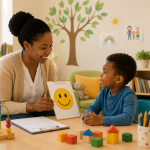




Mathematics begins long before children enter a classroom or learn to write numbers on paper. From noticing that one toy is bigger than another to counting steps, sorting objects, and recognising patterns, young children encounter mathematical ideas throughout their everyday lives.
Developing early mathematical skills helps children make sense of the world around them. These skills support problem-solving, reasoning, spatial awareness, observation, and the ability to recognise relationships between objects and events. When parents and caregivers introduce mathematical concepts through ordinary activities, children can discover that learning is practical, meaningful, and connected to their daily experiences.
The most effective early learning opportunities do not always require worksheets, flashcards, or expensive educational toys. Simple interactions at home, during play, while shopping, or when helping with household routines can introduce important mathematical ideas in ways that are appropriate for a child’s age and development.
What Are Early Mathematical Skills?
Early mathematical skills include much more than counting from one to ten. They involve recognising quantities, comparing sizes, identifying patterns, understanding shapes, noticing differences, and developing an awareness of space and measurement.
A toddler may begin by recognising that a plate has more pieces of fruit than another plate. A preschool child might arrange blocks from smallest to largest or notice that a particular pattern repeats. These everyday discoveries help children build the foundations for more formal mathematics later.
Number awareness is one important part of this process. Children gradually learn that number words correspond to quantities and that the final number counted tells them how many objects are in a group. Repeating number words is useful, but understanding what those numbers represent is equally important.
Other early mathematical concepts include sorting objects by colour or size, recognising circles and squares, comparing heavy and light objects, and understanding words such as under, beside, between, longer, shorter, more, and less.
Children develop these abilities at different rates. Providing opportunities to explore without unnecessary pressure allows them to build understanding through experience.
Counting During Everyday Routines
Daily routines provide natural opportunities to introduce counting. Parents can count steps while walking, count pieces of clothing while getting dressed, or count toys while putting them away.
For example, when a child is helping set the table, a caregiver might ask how many plates are needed or invite the child to count the spoons. These activities connect numbers with real objects and familiar purposes.
It is helpful to begin with small quantities and use objects that children can see and touch. A young child may understand counting three blocks more easily when moving each block as the numbers are spoken.
As children become more confident, caregivers can introduce slightly larger groups, encourage them to count objects independently, and discuss whether there are enough items for everyone.
The goal is not to test children constantly. It is to make numbers a natural part of everyday conversations and experiences.
Learning Shapes and Patterns Through Play
Shapes and patterns are present in many familiar environments. Children can discover circles on plates, rectangles on doors, squares on floor tiles, and triangles in pictures or building toys.
Caregivers can encourage observation by talking about these shapes during ordinary activities. Asking a child to find another object with a similar shape helps develop visual awareness and comparison skills.
Patterns can be explored through building blocks, coloured objects, music, movement, and household items. A simple sequence of red, blue, red, blue blocks can introduce the idea that a pattern follows a rule. Children might also clap, tap, or move in repeating sequences.
As their understanding develops, children can predict what comes next, create their own patterns, and notice similarities between different sequences.
These experiences encourage children to observe carefully, make connections, and explain what they notice. They also provide opportunities for creativity because children can explore many different ways to arrange and combine objects.
Introducing Measurement Through Everyday Experiences
Measurement can be introduced through familiar comparisons rather than formal measuring tools. Children can explore which container holds more water, which toy is longer, or which object feels heavier when handled safely.
Cooking and food preparation can also introduce measurement concepts. Under adult supervision, children may help compare quantities, observe ingredients being added, or notice differences between full and empty containers.
Caregivers can use simple language such as more, less, taller, shorter, heavier, lighter, full, and empty. Repeating these words in meaningful situations helps children connect mathematical language with what they can see and experience.
As children grow, they may become interested in comparing the lengths of objects using blocks, estimating how many steps it takes to cross a room, or noticing how long an everyday activity takes.
The purpose of these activities is to develop curiosity and understanding rather than expecting young children to master formal measurement techniques too early.
Developing Problem-Solving Skills Through Building Activities
Construction play offers valuable opportunities for mathematical thinking. When children build with blocks, stack cups, arrange boxes, or create structures from suitable materials, they experiment with balance, size, shape, position, and quantity.
A tower that falls over can become an opportunity to investigate what happened. A caregiver might ask whether a wider base would help or encourage the child to try placing a larger block at the bottom.
These experiences introduce early reasoning. Children begin to notice cause and effect, test ideas, compare outcomes, and make adjustments.
Adults can support this process by asking open-ended questions rather than immediately providing solutions. Questions such as “What could we try next?” or “How can we make it taller?” invite children to think independently.
Mistakes should be treated as a normal part of learning. When children are encouraged to experiment and try again, they can develop persistence and confidence alongside their mathematical understanding.
Exploring Maths Through Shopping and Household Tasks
Everyday family activities can make mathematical concepts meaningful. During shopping, children might help count a few familiar items, compare package sizes, or identify shapes and numbers on labels. Adults can also discuss quantities while arranging groceries or dividing suitable items between family members.
Household routines offer similar opportunities. Sorting laundry by colour, matching pairs of socks, grouping toys by type, or organising books by size introduces classification and comparison.
Children can participate in these tasks according to their age and abilities. Younger children may simply match two similar objects, while older preschoolers may be able to sort items according to more than one feature.
These experiences show children that mathematical thinking is useful outside a classroom. They can also encourage independence by giving children a meaningful role in family routines.
Using Stories, Music, and Conversation to Support Mathematical Thinking
Stories and songs can introduce numbers, sequences, comparisons, and patterns in enjoyable ways. Counting songs help children become familiar with number words, while stories about journeys, animals, or everyday situations can encourage children to compare quantities and anticipate what might happen next.
Caregivers can pause during a story to ask simple questions. They might ask how many animals are shown in a picture, which object appears larger, or what could come next in a repeating sequence.
Conversations are just as valuable as formal activities. Describing a staircase as having many steps, noticing that a container is almost empty, or comparing the sizes of two toys introduces mathematical language naturally.
Children should also have opportunities to explain their own observations. Even when their explanations are incomplete, listening and responding thoughtfully can help extend their thinking.
Supporting Children Without Creating Learning Pressure
Children do not need to complete formal lessons every day to develop early mathematical skills. In fact, too much pressure to answer correctly can make learning feel frustrating or intimidating.
A more supportive approach involves following the child’s interests, introducing manageable challenges, and allowing enough time to explore. If a child enjoys vehicles, counting toy cars or comparing their sizes may be a natural starting point. If a child enjoys drawing, exploring shapes and patterns through pictures may be more engaging.
It is important to remember that mathematical development is not identical for every child. Some children may readily recognise numbers but need more experience comparing quantities. Others may understand shapes and spatial relationships before becoming confident with counting.
Providing different ways to explore concepts helps children participate according to their strengths and individual needs. If a child experiences persistent difficulties with learning or everyday activities, parents can discuss their observations with an appropriate educator or qualified professional.
The Role of Parents and Early Childhood Educators
Parents and early childhood educators can work together to create meaningful learning opportunities. Sharing information about a child’s interests, strengths, and current abilities can help adults choose activities that are engaging without being overwhelming.
Educators can introduce mathematical concepts through play, practical tasks, group activities, and the learning environment. Parents can reinforce these ideas at home by talking about quantities, noticing patterns, and involving children in everyday routines.
Consistency does not mean repeating the same exercise every day. It means giving children regular opportunities to encounter concepts in different contexts so that they can build a deeper understanding.
Adults also play an important role in shaping children’s attitudes towards mathematics. When they approach numbers, shapes, and problem-solving with curiosity and encouragement, children can begin to view challenges as opportunities to learn.
Building a Strong Foundation for Future Learning
Early mathematical skills develop through many small experiences. Counting objects, comparing sizes, sorting household items, recognising patterns, and solving simple problems can all help children build the foundations for later learning.
These activities also support broader abilities, including language, reasoning, attention, and independent thinking. By connecting mathematical ideas to familiar situations, parents and caregivers can make learning accessible and relevant to each child.
At Grace Empowered Early Years, we recognise the importance of nurturing every child’s curiosity and individual development. Children deserve supportive environments where they can ask questions, explore possibilities, learn from mistakes, and develop confidence in their abilities.
You do not need a complicated lesson plan to begin. A few blocks, a shared story, a simple household task, or a walk around the neighbourhood can become an opportunity for discovery.
When children are encouraged to explore the world around them, everyday moments can become meaningful foundations for lifelong learning.