


“There is no one giant step that does it. It is a lot of little steps.”
When it comes to child development, progress does not always happen through one big achievement. More often, it happens through many small moments that gradually build towards greater independence. A child reaching for a toy, touching an object, attempting to pick something up, responding to a simple instruction, or taking one supported step may seem like a small accomplishment, but each of these moments can represent an important part of their developmental journey.
At Grace Empowered Early Years Foundation, we understand that every child develops at their own pace. Early intervention is not about rushing a child towards a particular milestone. It is about understanding where the child is today, recognising their strengths, identifying the areas where they may need support, and creating meaningful opportunities for them to practise and develop new skills.
With consistent passive movement, active movement can gradually be encouraged. For some children, movement may initially require additional support and guidance. Through repeated and appropriate movement experiences, children can become more familiar with how their bodies move and may gradually begin to participate more actively. What begins as a supported movement can eventually become a movement initiated by the child. The process takes patience, consistency, encouragement, and an understanding of the child’s individual needs.
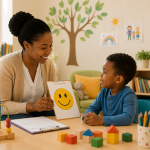
Fine motor development can also begin with very simple activities. Building fine motor skills by encouraging a child to touch and pick up an object can help create opportunities for developing hand control, coordination, attention, and purposeful movement. A simple activity such as reaching towards a toy or picking up an object can involve much more than the movement of the hand. The child is also learning to focus, coordinate their eyes and hands, understand the task, and participate in an interaction.
At the same time, these activities can provide an opportunity to understand the child’s language development. When a child is asked to “touch the ball” or “pick up the block”, we can observe how they respond to language and whether they understand what is being communicated. A simple physical activity can therefore become an opportunity to encourage both fine motor development and language understanding.
Movement can also support the development of gross motor skills. Activities such as climbing stairs can help children practise balance, body coordination, strength, movement planning, and confidence. Each step requires the child to coordinate their body and understand how to move safely through their environment. With appropriate support and repeated opportunities to practise, these experiences can help children become more confident and capable in their movements.
The important thing is to look beyond the activity itself. A child climbing stairs is not simply climbing stairs. They may be developing balance, coordination, strength, body awareness, and motor planning at the same time. Similarly, a child picking up an object is not simply using their hands. They may also be developing attention, visual coordination, understanding, communication, and problem-solving skills.
Every child’s progress will look different. For one child, progress may be taking an independent step. For another, it may be reaching for an object without assistance. For another, it may be understanding a simple instruction or actively participating in an activity for a little longer than before. These small achievements are meaningful because they show that the child is learning, participating, and moving forward.
Consistency is an important part of this journey. Children need opportunities to practise skills repeatedly in meaningful and supportive environments. When therapists, educators, parents, and caregivers work together, developmental activities can become part of everyday routines rather than something that happens only during a therapy session.
At Grace Empowered Early Years Foundation, we believe that meaningful progress is built through patience, consistency, encouragement, and personalised support. We focus on the individual child and create opportunities for them to develop skills in ways that are engaging and relevant to their everyday lives.
There may not always be one giant step that changes everything. Sometimes progress is a collection of small movements, small attempts, small responses, and small achievements. Over time, those little steps can become something much bigger: greater confidence, greater participation, and greater independence.